
Reimagining NAAC Accreditation: Towards a Simpler, Smarter and More Contextual System
The accreditation of Higher Education Institutions (HEIs) plays an important role in improving quality, accountability and institutional performance. In India, the National Assessment and Accreditation Council (NAAC) has been central to this process. However, as higher education continues to expand and diversify, there is a growing need to make accreditation simpler, more transparent, technology-enabled and sensitive to the different contexts in which institutions operate.
The proposed reforms in the NAAC accreditation system point towards a significant shift: from a largely documentation-driven process to one that focuses more on quality improvement, institutional development and meaningful outcomes.
Strengthening Institutions Before Accreditation
One of the most important ideas is to strengthen institutions even before they enter the formal accreditation process. Many institutions, particularly those with limited administrative capacity, may struggle to understand complex requirements and prepare extensive documentation.
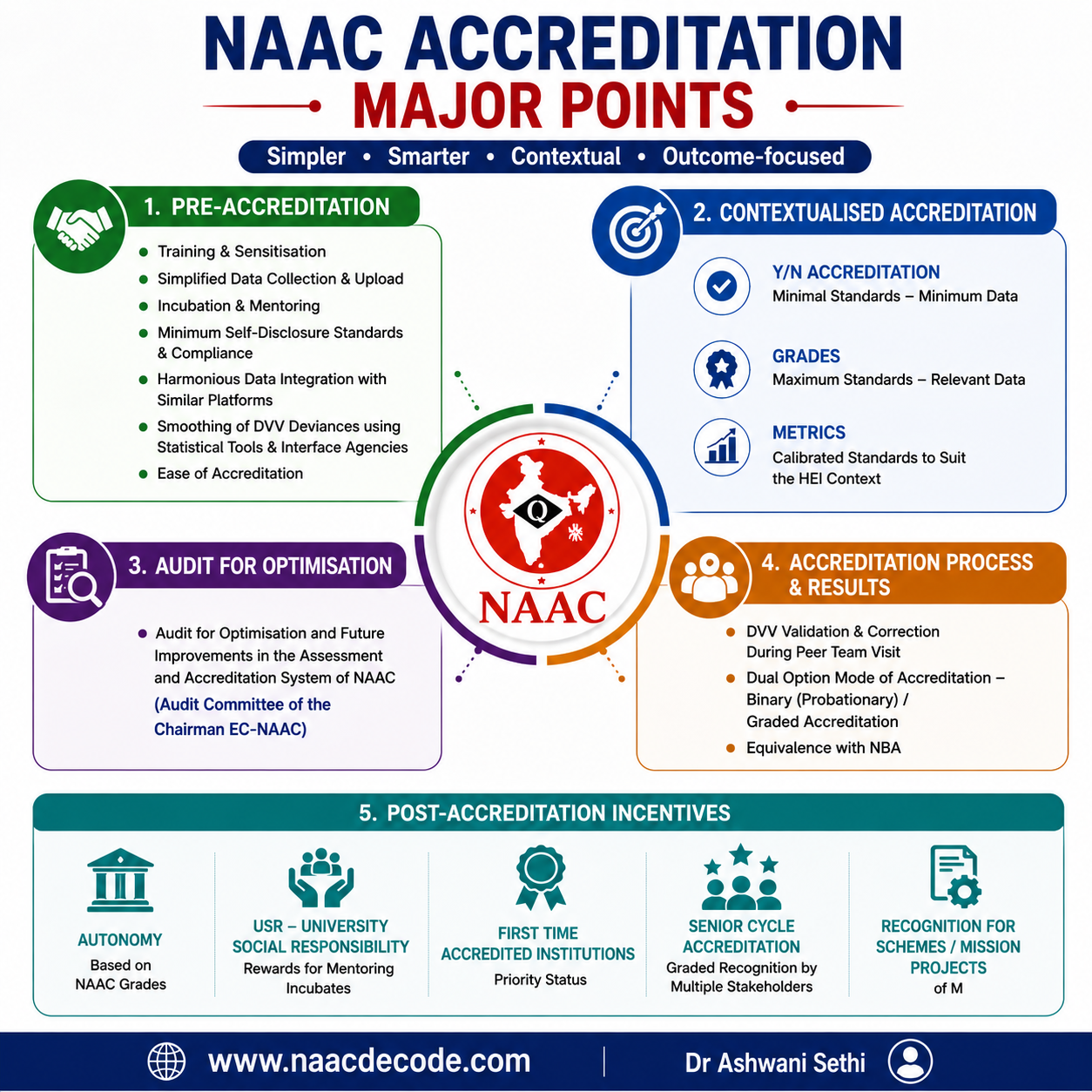
A strong pre-accreditation support system can address this challenge. Training and sensitization programmes can help institutions understand accreditation requirements in a practical manner. Mentoring and incubation can further support institutions that are preparing for their first accreditation or seeking to improve their performance.
Such an approach would transform accreditation from an event that institutions prepare for periodically into a continuous journey of quality enhancement.
Simplifying Data Collection and Upload
Data management is one of the most demanding aspects of accreditation. Institutions often have to collect, verify and upload large volumes of information. If similar information is already available on other government or educational platforms, repeatedly submitting the same data creates unnecessary administrative work.
The future accreditation system should therefore promote harmonious data integration with existing platforms. Wherever reliable data is already available, it should be possible to access and verify it through integrated systems rather than requiring institutions to submit it repeatedly.
Technology can also make the process more efficient through automated validation, dashboards, analytics and statistical tools.
A Contextualised Approach to Accreditation
Perhaps the most significant proposed change is the idea that accreditation should be contextualised.
Higher Education Institutions are not identical. A large multidisciplinary university, a specialised institution, a rural college and a newly established institution may have very different missions, resources and student profiles.
Therefore, applying identical expectations to every institution may not always provide a fair picture of institutional quality.
A more flexible model could include three broad levels:
- Binary accreditation: Focused on minimum standards and essential data.
- Graded accreditation: Recognising institutions that demonstrate higher levels of achievement using relevant and comprehensive data.
- Contextualised metrics: Using calibrated standards that take the institution's mission, size, location and other relevant characteristics into account.
This approach can preserve minimum quality standards while allowing institutions to demonstrate excellence in ways that are appropriate to their individual contexts.
Making DVV More Transparent and Efficient
Data Validation and Verification (DVV) is an important part of ensuring the reliability of institutional information. However, discrepancies identified during validation can sometimes become a major challenge for institutions.
The proposed use of statistical tools and interface agencies could make this process smoother. There is also a proposal to permit appropriate validation and correction of DVV discrepancies during the Peer Team Visit.
Such mechanisms could reduce unnecessary procedural difficulties while maintaining the credibility and integrity of the accreditation process.
A Dual-Option Accreditation Model
Another interesting proposal is the introduction of a Dual Option Mode of Accreditation.
Under such a system, institutions could potentially be assessed through:
- Binary or Probationary Accreditation, providing recognition that minimum requirements have been met; and
- Graded Accreditation, recognising different levels of institutional performance.
This could make accreditation more accessible to institutions that are still developing while also creating a pathway for stronger institutions to demonstrate higher levels of achievement.
In this sense, accreditation would become not merely a judgement, but a mechanism for continuous institutional progression.
Accreditation Should Lead to Real Benefits
Accreditation becomes more meaningful when it produces tangible benefits for institutions.
One proposed reform is to link institutional autonomy more closely with NAAC grades. Institutions demonstrating sustained quality could receive greater academic and administrative flexibility.
Similarly, the idea of University Social Responsibility (USR) could encourage well-performing institutions to mentor and support institutions that are still developing. Instead of viewing accreditation as a competition, this would create a culture of collaboration and shared improvement.
Institutions receiving accreditation for the first time could also receive priority in appropriate initiatives, while senior-cycle accreditation could provide broader recognition from stakeholders for participation in various schemes and mission-oriented projects.
From Compliance to Continuous Improvement
The real success of accreditation should not be measured only by the certificate or grade an institution receives. Its greater purpose should be to encourage institutions to continuously examine themselves, identify weaknesses and improve.
For this reason, the future of NAAC should focus on moving from compliance to continuous quality improvement.
A simpler process does not mean a weaker process. On the contrary, reducing unnecessary paperwork can allow institutions and evaluators to focus more attention on what really matters: teaching and learning, research, student development, governance, community engagement, innovation and institutional outcomes.
Conclusion
The proposed reforms represent an opportunity to rethink accreditation for the changing landscape of Indian higher education. A simpler, technology-enabled, integrated and contextualised accreditation system can reduce the burden on institutions while strengthening accountability and quality.
The ultimate goal should be to create an accreditation framework that institutions do not merely prepare for, but one that genuinely helps them improve, innovate and serve their students and society better.
If implemented effectively, the next generation of NAAC accreditation can move beyond paperwork and compliance towards a system based on trust, transparency, evidence, continuous improvement and institutional excellence.