
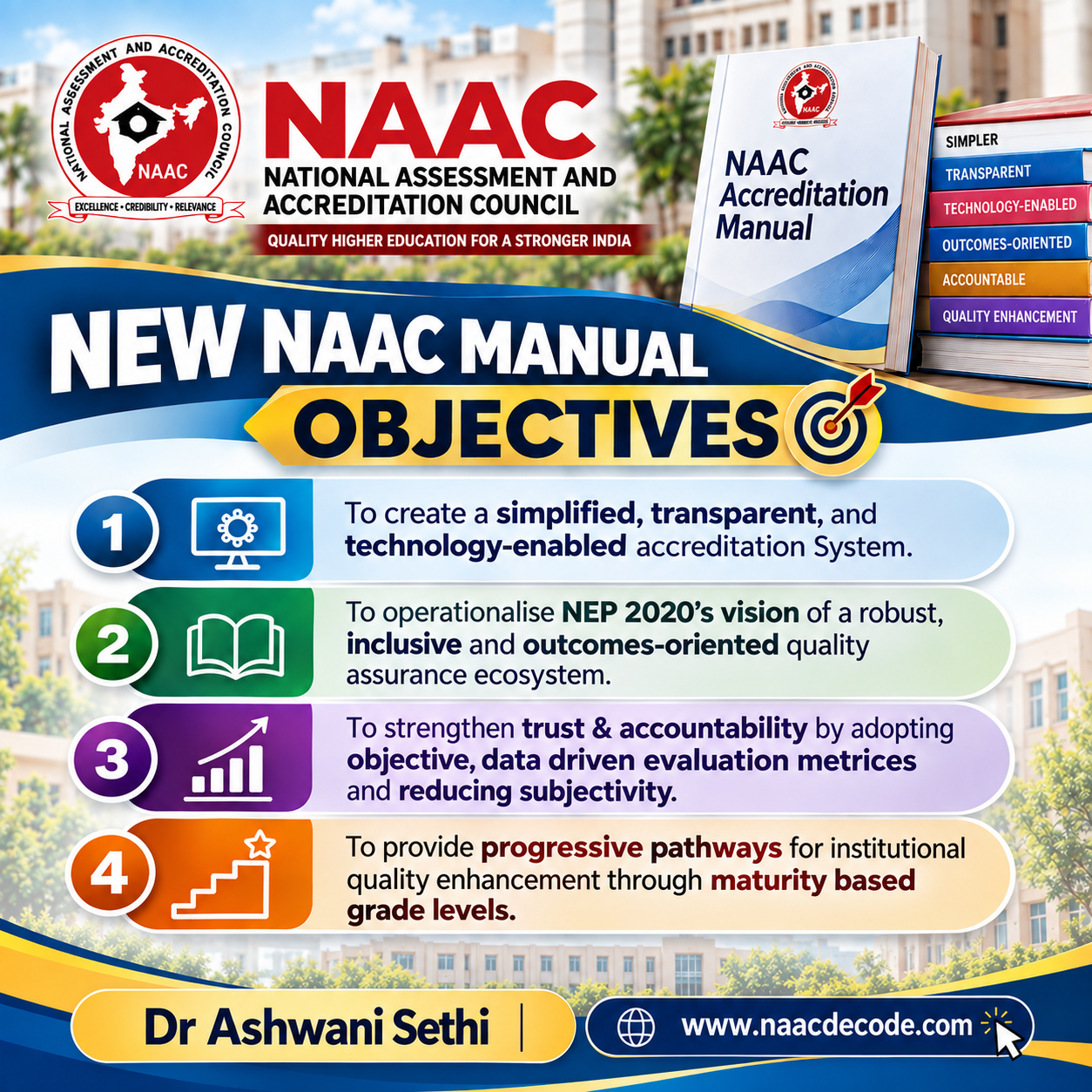
New NAAC Manual Objectives
A New Paradigm for Quality Assurance in Higher Education
Accreditation is not merely a process of assessment and grading; it is an important instrument for promoting a culture of quality, accountability, continuous improvement and institutional excellence in higher education. With the changing landscape of higher education and the increasing emphasis on technology, outcomes and transparency, the accreditation ecosystem is also evolving.
The New NAAC Manual represents a significant shift towards a more simplified, transparent, technology-enabled, objective and maturity-oriented accreditation framework. It seeks to align quality assurance with the vision of National Education Policy (NEP) 2020 and to encourage Higher Education Institutions (HEIs) to continuously improve their academic, administrative and institutional processes.
The objectives of the New NAAC Manual can be understood through four major pillars.
1. Creating a Simplified, Transparent and Technology-Enabled Accreditation System
One of the foremost objectives of the New NAAC Manual is to create an accreditation system that is simplified, transparent and technology-enabled.
Traditionally, accreditation has involved extensive documentation, multiple stages of data submission and considerable institutional effort in compiling and presenting evidence. While documentation remains important for ensuring accountability, the future of accreditation requires a system that makes the process more efficient and user-friendly.
Technology can play a transformative role in this regard. Digital platforms can facilitate:
· Online submission and verification of institutional data
· Digital documentation and evidence management
· Automated validation of information
· Real-time tracking of the accreditation process
· Data analytics and dashboards
· Reduction in repetitive documentation
· Greater transparency in assessment and decision-making
A technology-enabled accreditation system can therefore move the focus from volume of documentation to quality of evidence and institutional outcomes.
The objective is not simply to digitise the existing process but to reimagine accreditation through technology so that institutions can spend more time on quality enhancement and less time on procedural complexities.
2. Operationalising the Vision of NEP 2020
The second major objective is to operationalise the vision of NEP 2020 by developing a robust, inclusive and outcomes-oriented quality assurance ecosystem.
NEP 2020 places strong emphasis on multidisciplinary education, learner-centric approaches, innovation, research, employability, inclusion, technology integration and holistic development.
The New NAAC Manual seeks to strengthen these principles through an accreditation framework that looks beyond inputs and processes and gives greater importance to outcomes and impact.
This means that institutions will increasingly need to demonstrate not only:
What they have, but also:
What they do with it and what outcomes they achieve.
For example, quality assurance should consider the effectiveness of teaching-learning practices, student progression, research outcomes, innovation, community engagement, employability, inclusiveness and institutional development.
An outcomes-oriented approach can encourage HEIs to establish stronger internal quality systems and continuously evaluate whether their academic and administrative initiatives are actually producing the desired results.
Thus, accreditation becomes a mechanism for translating the philosophy of NEP 2020 from policy into institutional practice.
3. Strengthening Trust and Accountability Through Objective, Data-Driven Evaluation
The third objective is to strengthen trust and accountability by adopting objective, data-driven evaluation metrics and reducing subjectivity.
Trust is fundamental to any accreditation system. Students, parents, faculty members, policymakers, regulators and society at large expect accreditation outcomes to be credible, consistent and evidence-based.
The increasing use of institutional data provides an opportunity to strengthen this credibility.
A data-driven accreditation system can make greater use of:
· Verified institutional data
· Quantitative and qualitative indicators
· Defined evaluation metrics
· Digital evidence
· Performance trends
· Outcome-based indicators
· Comparative institutional benchmarks
· Data validation mechanisms
Such an approach can reduce excessive dependence on subjective interpretation and provide a more consistent basis for evaluation.
However, data should not be viewed merely as numbers. Data becomes meaningful when it demonstrates institutional performance, improvement and impact.
Therefore, institutions will need to develop strong systems for data governance, documentation, internal verification and evidence management.
This will also strengthen the role of the Internal Quality Assurance Cell (IQAC) as an institutional mechanism for monitoring quality, analysing performance and promoting continuous improvement.
4. Progressive Pathways for Quality Enhancement Through Maturity-Based Grade Levels
The fourth objective introduces an important philosophical shift: accreditation should not merely classify institutions; it should also provide progressive pathways for institutional quality enhancement.
Institutions differ significantly in their size, resources, geographical context, academic portfolio and stage of development. A single approach to quality assessment may therefore not adequately capture the diverse realities of higher education institutions.
A maturity-based approach can provide institutions with a progressive quality journey.
Instead of viewing accreditation as a one-time destination, institutions can be encouraged to move through different levels of institutional maturity by progressively strengthening their:
· Governance systems
· Academic processes
· Teaching-learning practices
· Research and innovation
· Student support
· Infrastructure
· Digital systems
· Institutional leadership
· Quality culture
· Social responsibility
· Continuous improvement mechanisms
From Compliance to Continuous Quality Improvement
The New NAAC Manual has the potential to redefine the way institutions perceive accreditation.
Accreditation should no longer be treated as an activity undertaken only when an assessment cycle approaches. Instead, quality should become an integral part of everyday institutional functioning.
The emerging framework places emphasis on four interconnected principles:
Simplification
Making accreditation processes easier, clearer and more efficient.
Technology
Using digital systems, data and analytics to improve transparency and efficiency.
Objectivity
Strengthening evidence-based and data-driven evaluation.
Maturity
Providing institutions with progressive pathways for continuous quality enhancement.
Together, these principles can establish a stronger and more sustainable quality assurance ecosystem.
What HEIs Need to Do Now
The changing accreditation environment requires institutions to prepare themselves strategically rather than reactively.
Higher Education Institutions should begin focusing on:
1. Strengthening institutional data systems and ensuring accuracy and consistency.
2. Digitising institutional records and evidence for easy retrieval and verification.
3. Developing outcome-based indicators for academic and administrative activities.
4. Strengthening IQAC mechanisms for continuous monitoring and quality improvement.
5. Creating a culture of evidence-based decision-making.
6. Mapping institutional activities with NEP 2020 priorities.
7. Monitoring institutional performance through dashboards and analytics.
8. Documenting continuous improvement initiatives and their impact.
9. Strengthening internal audits and data validation mechanisms.
10. Moving from accreditation preparation to continuous accreditation readiness.
The most successful institutions will be those that integrate quality assurance into their strategic planning, governance and daily operations.
The New NAAC Manual signals a broader transformation in the philosophy of accreditation. The emphasis is moving towards a system that is simpler, smarter, more transparent, more objective and focused on institutional maturity and outcomes.
The ultimate purpose of accreditation should not be merely to award a grade. Its larger purpose is to create institutions that continuously learn, evaluate themselves, improve their practices and deliver better outcomes for students and society.
This represents a transition from documentation-driven accreditation to data-driven quality assurance, from compliance to outcomes, and from one-time assessment to continuous institutional maturity.
For HEIs, this is not simply a change in an accreditation manual. It is an opportunity to build stronger institutions, strengthen stakeholder trust and create a sustainable culture of quality.
The future of accreditation is not just about measuring quality—it is about enabling institutions to continuously create, demonstrate and enhance quality.
Source: Ministry of Education, Govt of India